3D-Printed 80-Meter Doublet
I was looking to expand on the 40-meter dipole fed with 450ohm window line I set up when I first got my license. It tuned most bands 40 meters and higher with my MFJ-976 (10 meters was very difficult), but I thought I could do better (and include 80 meters as well!)
I wanted to run each side of the feedline into each leg of the resonator as one continuous wire, eliminating any losses or potential failures at the feedpoint. Researching this concept, I found others who had done something similar before me, but most used cut and drilled wood, polycarbonate, or PVC for the center insulator. This seemed rather crude, so why not create something purpose-built and put my 3D printer into service for the cause! It also turned out to be a good exercise in developing my Fusion360 skills. I went through several design iterations and printed prototypes before I found something I was happy with.
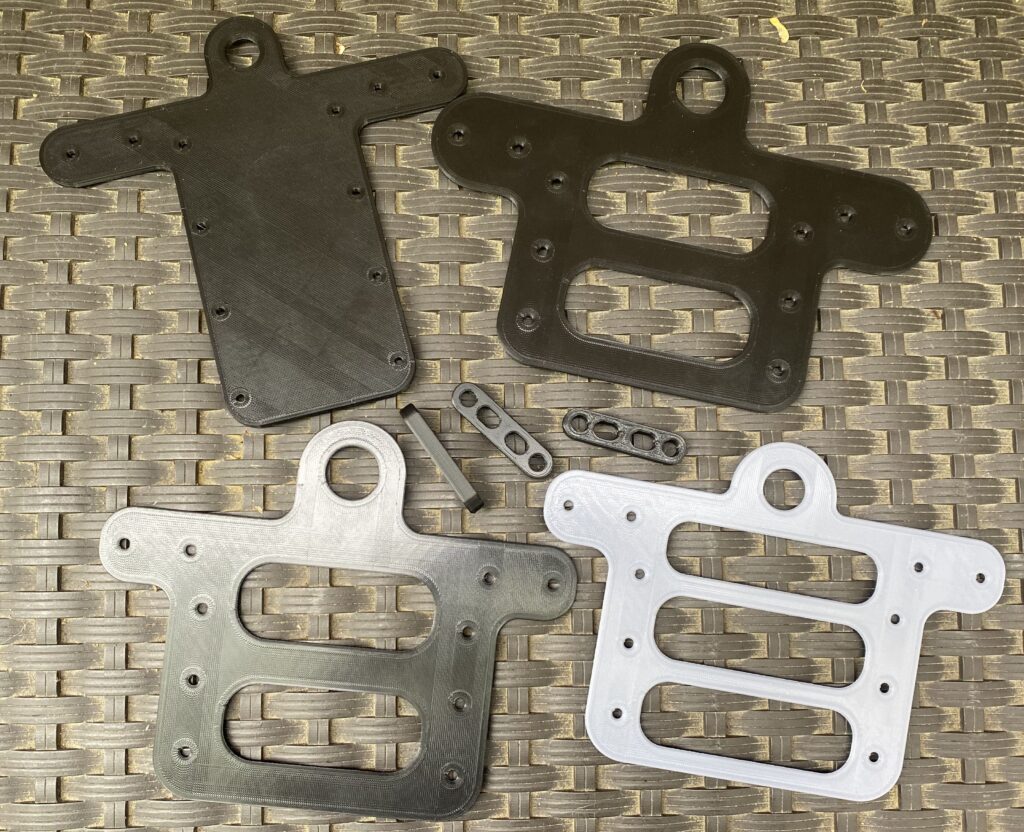
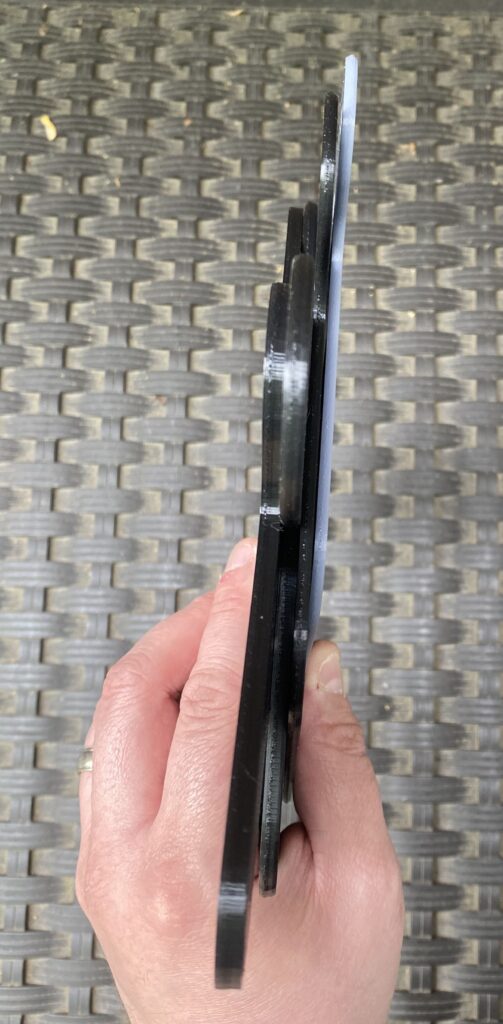
I learned a major design lesson working on this project: how to save plastic and print time eliminating wasted space. I found I could still achieve the rigidity I needed with a much thinner print and reduce weight with cutouts in the design. Some inspiration for the final design came from this ingenious creation by PD5DJ meant for window line. I also used their end insulator model. I chose a grey-colored PLA filament for the final print, hoping it would absorb less heat from the sun and last longer outside.
I used a very handy transmission line calculator (by Serge Y. Stroobandt, ON4AA) to determine my ladder line spacing for a 600 ohm impedance (This was incorporated into my center insulator design). The wire I chose was 14AWG Stranded THHN wire (A roll of 500 feet was about $40 at Home Depot). Other Hams have come up with some great ladder line spacer ideas; electric fence insulators, sprinkler tubing and zip ties, and plastic coat hangers, for example. There are even some commercially available options. Once again, I figured I could press my 3D printer into service for a solution. Lo and behold, I stumbled across this set of designs on Thingiverse, which included wire spreaders that were dynamically adjustable via an OpenSCAD model. The design was also remixed to add some strength for longer spacers, perfect for my application. I edited the OpenSCAD model to get my desired spacing (121.4 mm center to center) and printed about 150 of them for my 80ft of feedline. This took a while.

With my wire and all my printed parts gathered, it was time to begin assembling the antenna. I measured and cut two lengths of wire 150 ft long; marked at 63.5 feet for one side of the resonator and about 86 feet of feedline, giving me some excess for adjustments. The antenna will be erected in an inverted-V configuration and tuned for 3.5 MHz. The wires were carefully threaded through the center insulator up to the 63.5-foot mark.

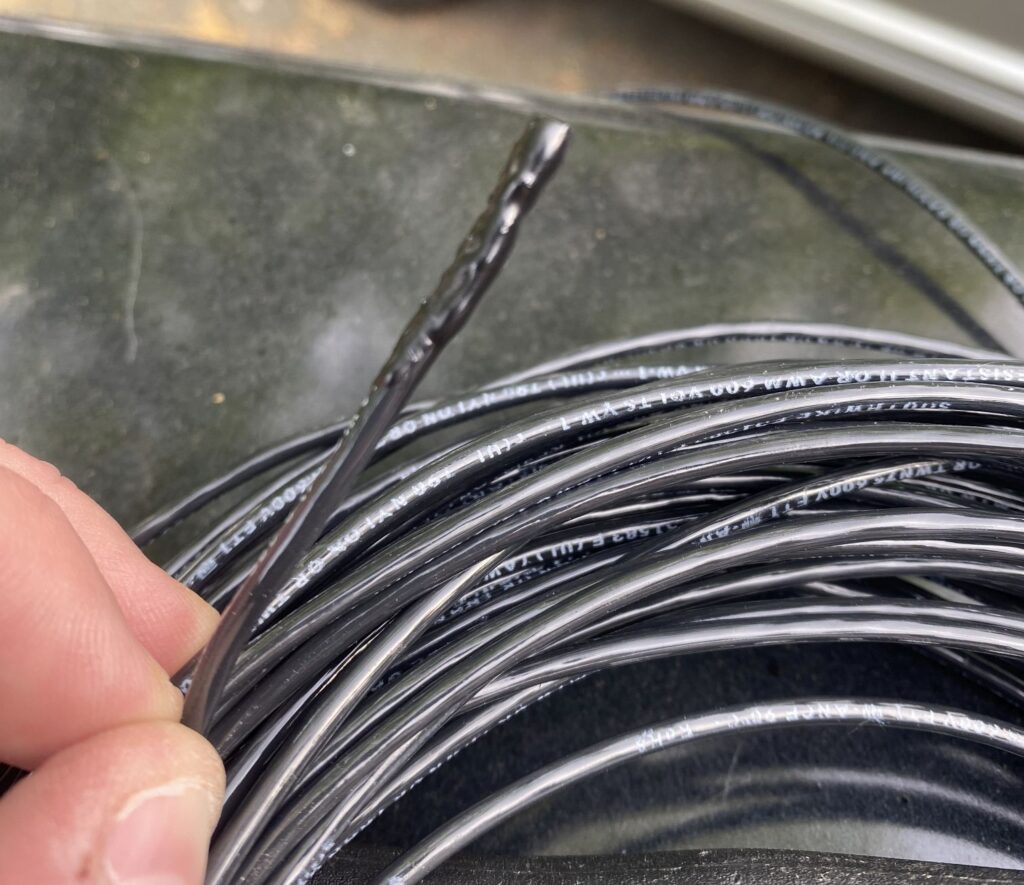
I also coated the ends of the radiating elements in liquid electrical tape to prevent moisture from getting under the insulation. THHN wire isn’t meant for the outdoors, so we’ll see how it holds up over time.
I got a support line about 40 feet up in the tree in my backyard and decided I would attach the ladder line spacers gradually as the antenna was pulled up.
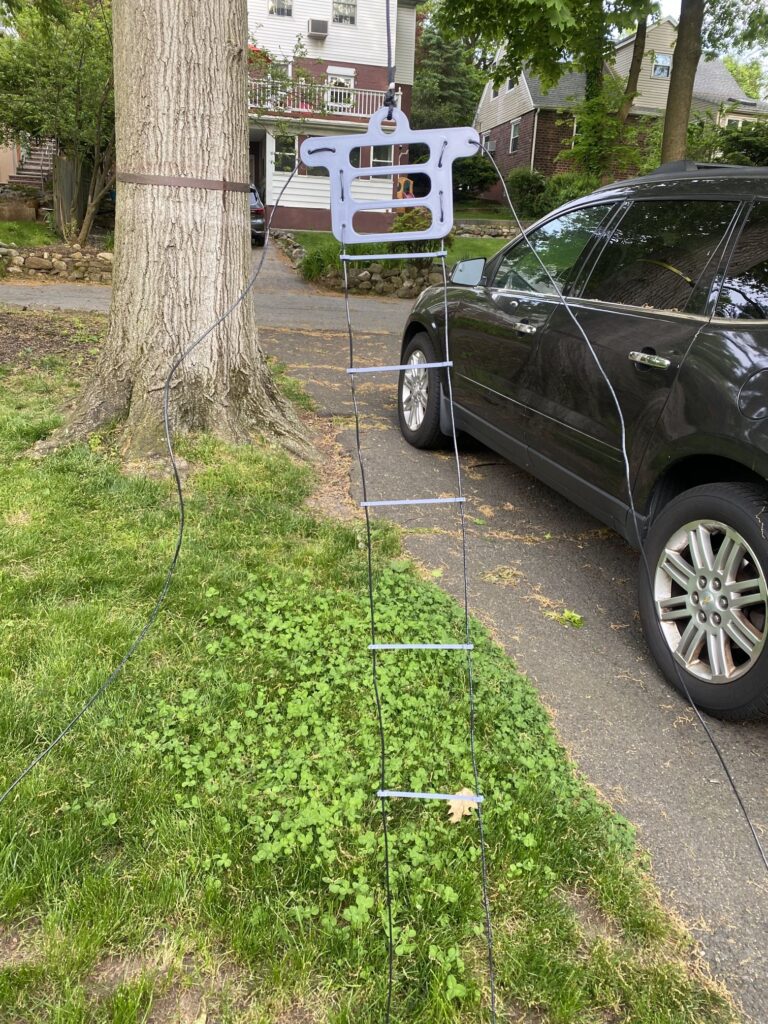
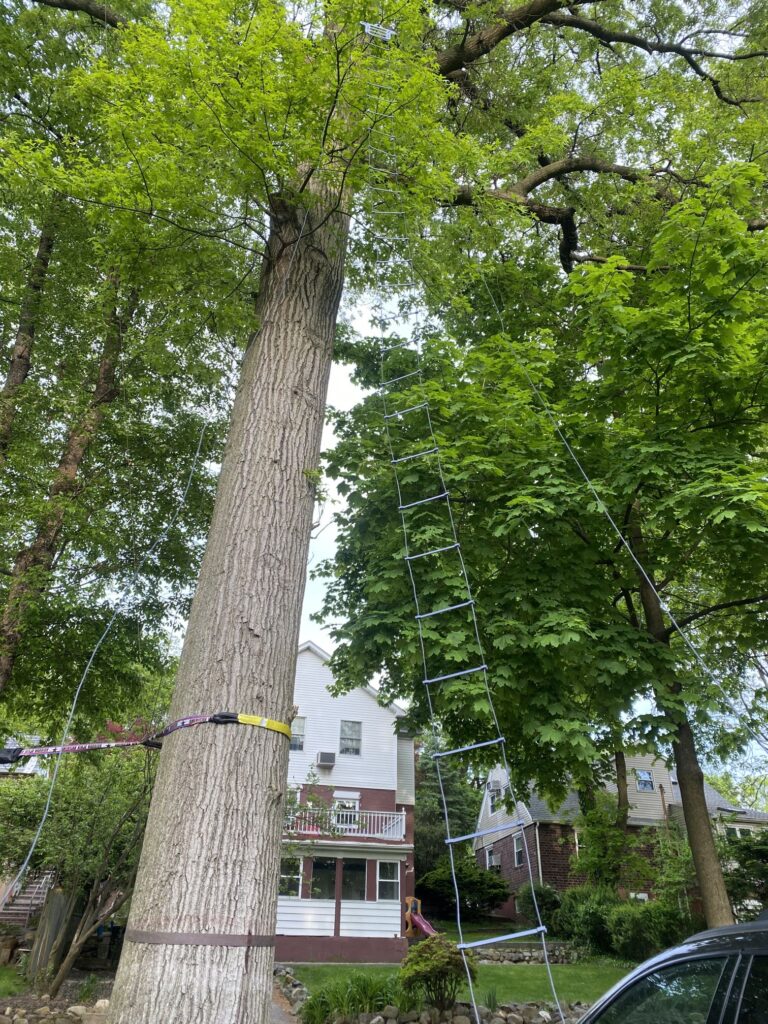
It turns out that 80+ feet of ladder line is quite heavy (!!), so I installed an anchor in the tree and a runner to support the line to its termination point on the side of my garage.
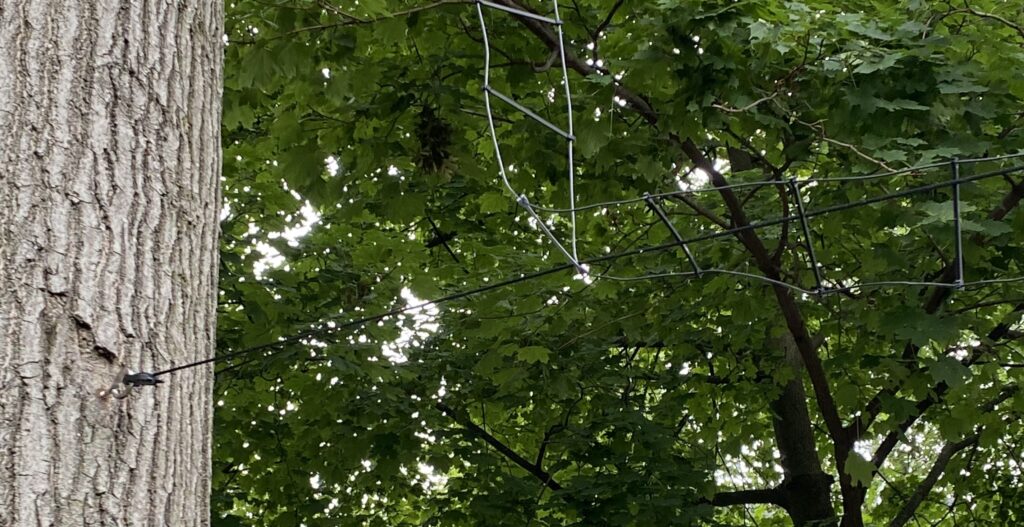
The end of the feedline terminates at a balanced line lightning surge protector and from there to a Balun Designs 4:1 Balun. A short run of RG-8 coax takes it into the shack.
One end of the radiator is pulled out to a point about 15 ft off the ground at a tree in my front yard, and the other end through the large tree in my back yard where half of the radiator hangs straight down. Not ideal, by any means, but it works for my QTH.
Conclusions
Overall, I’m pleased with the results. The wire was about $40 and I have a couple hundred feet left over for other projects, and the printed parts (including prototypes) used about $10-15 worth of plastic filament. The antenna tunes up well on 80m, 40m, 30m, 20m, and better than my old antenna on 10m. The noise floor at my QTH is pretty high, particularly on 80 meters, but there might not be a lot I can do about that.
I have used this antenna to make contacts all over the world and that’s good enough for me for now.
73,
Jay W2OG
Hi Jay, that sounds like a great antenna system!
I’m on a Monsey Trails bus on today’s commute home — we were right behind your car for mile or so, and I saw your license plate.
When I built my first 80 meter antenna, I used a piece of plexiglass, drilled holes in it and then attached the RG59 with a small clamp. It was probably full of losses but it was enough to get me going. As a 13-year-old Novice licensee, I was thrilled with the results.
All the best!
Thanks for sharing your work. I needed something similar for my Field Day antenna- and it turns out you can find dozens of STLs for doublets fed with 450 or 300 ohm, but precious few for 600 ohm feedline… which is what I’ve got spacers for. I took some cues from your post here, strengthening the wall loops but talking out some gaps in the middle. It held up and performed well- thanks for the inspiration.